Learn how the ear works so we can perceive sound and keep our balance. Understanding how the ear works can help people better understand deafness. You might like to share this information with your child’s club, coach, or instructor.
Parts of the Ear
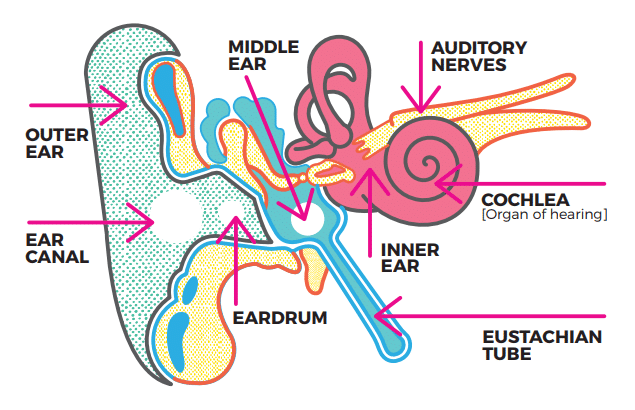
Our ears are divided into three main parts.
- The External (or Outer Ear)
The sound travels through the external (or outer) ear and causes the eardrum to vibrate. - The Middle Ear
The vibrations from the eardrum then pass along to the very tiny bones (called the ossicles) in the middle ear and cause them to vibrate - The Inner Ear
The vibrations from the small bones in the middle ear causes small waves in the fluid inside the cochlear. The cochlear is shaped like a snail’s shell, is very intricate and complex and has about 24,000 very tiny hair cells.
In the cochlear, the hair cells are arranged so that high frequency sounds can be detected at one end of the spiral and low sounds at the other end. Each hair cell can detect one frequency. They are connected to a nerve fibre and the movements produce electrical activity in the auditory nerve. The electrical activity then travels along the auditory nerve to the brain. Once the brain receives the nerve impulse, it is interpreted as sound.
What about balance?
Balance is controlled by the semi-circular canals in the inner ear. They are filled with fluid and the fluid moves when a person moves. The signal plus information from the other senses is sent to the brain to enable us to keep our balance.